

© 2025 - Anglo Italian Family History Society
Website by Beachshore
Click on the links below or on the side panel to the left and discover more information to guide your research:
The Society for Italian Studies
The Society for Italian Studies (SIS) is to further the study of Italy, Italian language, literature, film, thought, history, society and arts in the United Kingdom and Ireland. It represents the discipline, providing a voice for Italian Studies at national and international level and participating in the work of the University Council of Modern Languages (UCML) to promote the study of Modern Languages. It supports research through the work of its journal, Italian Studies; through its biennial and interim conferences; through its grants for conferences and for collaborative research projects; through its support of the post-graduate community; and through its involvement in national and international research exercises.
London News 24: Digital Magazine of the Italian System in London and the United Kingdom.
Editor in chief: Pietro Nigro, journalist enrolled in the register of professional journalists.
Giuseppe Mazzini: Italian patriot and major figure in the making of Italy
Mazzini lived in modest London lodgings, surrounded by book, papers and the tame birds in which he delighted; he studied at the British Museum and wrote for English periodicals. Though he had little money, he started a school for Italian boys in London and a newspaper, Apostolato popolare (“Apostleship of the People”) * in which he published part of his essay “On the Duties of Man.” In 1840, with the help of Giuseppe Lamberti in Paris, he revived Young Italy, primarily as a means of building up a national consciousness amongst Italians everywhere.
For more information see an article in Italian Roots by Andrea Del Cornò: Revolution in Print: Mazzini’s Journalism in London 1840-1859
Memory Sites and Collective Memory: Prof. Ann Rigney
NITMS: Network in Transnational Memory Studies.
It's behind you: a look into the history of pantomime
The story of pantomime is a tale of dragons and serpents. It features men dressed as women, and women masquerading as young men. Pantomime presents a tale of good an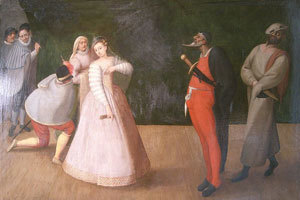 d evil, where hope triumphs over adversity after danger and virtual despair. It has its roots in ancient Greece, and via Italy and France, insinuates itself into Britain.
Commedia dell’Arte is an Italian Renaissance form that is best known as a style that features characters wearing half masks, of which there are many, but there are also many characters within commedia dell’arte that do not wear masks. Famous characters, such as Harlequin, Pantaloon, Punch and Pierrot have survived across the generations, being assimilated into art, literature, music, opera and film. Many practitioners now refer to the form as simply ‘commedia’ as the ‘dell’arte’ was an addition made by Carlo Goldoni in the 18th century, long after commedia’s hey day in the 16th and 17th centuries. Commedia is also a more flexible term that can allow for modern developments within the genre.
Transnational Memory: Prof Ann Rigney
A discussion of cultural and travelling memory as people - and their stories - move across borders .
Prof Ann Rigney on Commemorations
Italy Made in Britain.Contemporary British Perspectives on Italian Culture
How does contemporary Britain perceive and imagine Italy and how does it mirror itself in Italy’s image? This publication aims at interrogating the current clichés about Italy, showing how imagery about the country is multi-faceted and prismatic, highlighting areas of dialogue as well as tendencies towards stereotyping. It problematises the images of Italy as it is seen in a variety of layers of British society - from the media, to film, to politics - showing how the construction of the southern European country still corresponds to a horizon of expectations more than to reality. While a large amount of scholarly attention has been devoted to the image of Italy through the centuries, little has been written so far on how the British world perceives Italy today, in the late twentieth and twenty-first century. The issue focuses precisely on narratives of the last few decades, (re-) examining a number of positive and negative stereotypes of the peninsula in today’s Britain, and where necessary widening the comparison to take into account the wider Anglophone world. The originality of the issue lies in the attempt to understand Italy as a complex set of cultural phenomena, observing it from a multi-disciplinary standpoint (Italian Studies, History, Media Studies, Translation Studies). Edited by Giacomo Comiati, Martina Piperno and Kate Willman.
Migrant descendants (i.e. the so-called second generations) represent an increasingly important share of the European workforce. Their belonging to multiple cultures could help them develop intercultural competence (IC), a vital asset in contemporary labour markets. Intercultural competence of migrant descendants, however, have been under-researched in both migration and intercultural studies and should be better examined to maximise the resources available in multi-ethnic societies while improving migrant descendants work opportunities.
The Oceanides, York House, Twickenham, Greater London,” by Oscar Spalmach (Italian, 1864-1917)
Carved in Carrrar Marble in the the Roman studio of Orazio Andreoni at the turn of the nineteenth century. These sculptures were brought to England to adorn the Surrey property of Whitaker Wright, but were dispersed when in 1904 he was found guilty of fraud and unexpectedly died. Similar pieces from his collection can be seen in the Beale Wildllife Park near Pangbourne. The York House Garden Statues came to Twickenham in 1909 still in their packing cases, bought for £600” by the last person to own York House and arranged in their present display” by the firm of J. Cheal & Sons, specialists in handling garden statuary.
Website by Beachshore