

© 2025 - Anglo Italian Family History Society
Website by Beachshore
Internment

Click on the links below and in the side panel to the left to discover more information to guide your research:
A new resource by The National Archives Education Service, Behind the Wire, traces the locations of prisoner of war (POW) and internment camps in the UK through a series of interactive maps. A total of 538 camps have been mapped, including 510 POW camps and 28 internment camps. Of these, 430 camps were in England, 54 in Scotland, 25 in Wales, 14 in the Isle of Man, 13 in Northern Ireland, 1 in Guernsey and 1 in Jersey. The resource provides the names of the camps together with the dates when they were in operation and links to relevant documents held at The National Archives, such as camp correspondence, inspection reports and war diaries.
British internment and the Internment of Britons, ed. Gilly Carr and Rachel Pistol
'In recent decades there has been a marked growth in scholarship on the internment of continentals in Great Britain during the Second World War ... information is still coming to light to build an even more nuanced and full picture of what happened to 'enemy aliens'* during this period. From fragmented records, detective work has been required to fully reconstruct exactly what happened during this time period and how it has been remembered and commemorated. This volume has been created to fill a gap in internment scholarship and to offer a comparative approach that considers the internment of continentals in Britain alongside the internment of Britons on the continent.'
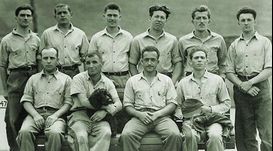
The internment of enemy aliens during World War Two
A talk given by Dr Rachel Pistol talks on Internment, the sinking of SS Arandora Star and internees taken to Australia on the HMT (Hired Military Transport) Dunera.
Podcast: Collar the Lot. Members' Area
A podcast from a BBC programme about the internment of Italian nationals on the Isle of Man. It includes the experience os Scots Italian actor, Tom Conti's family.
Tatura, Australia. 1943. Italian internees from overseas interned
Within the Australian War Memorial's collection, there are a number of items which hold a wealth of useful information for all types of research. These records hold in depth, often first-hand, accounts of the operations in which Australian have been involved.
The Association of Jewish Refugees: the national charity supporting Holocaust refugees and survivors living in Great Britain.
The Arolsen Archives
The Arolsen Archives has an extensive collection of documents about the victims and survivors of National Socialism. The Archives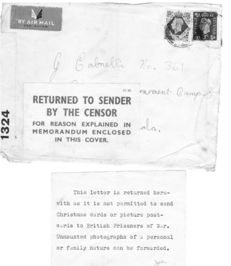 include documents on concentration camps, forced labour and displaced persons and contain references to around 17.5 million people.
Manchester's Little Italy at War, 1940-1945: enemy aliens or reluctant foe?
Article by Paul di Felice on Manchester’s Italian community during 1940-1945.
Tatura Internment Camps, Australia
The Tatura group of 7 internment camps held between 4 and 8,000 people at any one time; these camps were located at Tatura (camps 1 and 2), Rushworth (camps 3 and 4), Dhurringile Mansion, Murchison (camp 13) and Graytown.
Dangerous Characters: anti-Fascism and the Arandora Star
A documentary by Alfio Bernabei, covering interwar anti-fascism and interviews with survivors of the Arandora Star tragedy.
When Britain interned its wartime refugees
Before May 1940, not a single person interviewed by the polling group Mass Observation suspected refugees to Britain of espionage, or suggested that they should be interned. Up until then, only 569 individuals had been interned, either through MI5’s initial roundups or as the result of mandatory tribunals where senior judges had tested the loyalties of tens of thousands of asylum seekers. Some critics had always maintained that the home secretary’s policy had been too feeble. In April 1940, after the German occupation of Norway made an invasion of Britain seem possible, Col Henry Burton, Conservative member for Sudbury, asked members of the House of Commons if it would not be “far better to intern all the lot and then pick out the good ones”.

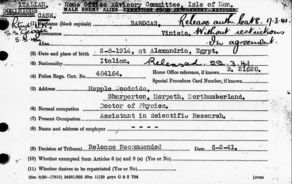
Listing of Camps and Ghettos: 1933 - 1945 under European Regimes aligned with Nazi Germany
Camps and ghettos set up under European regimes aligned with Nazi Germany during World War Two. They include camps ln Italy, Italian occupied Albania, East and North Africa, Greece and France and held persons of Italian and non-Italian citizenship.When Italy entered the war on June 10, 1940 the Fascist government established a system of concentration camps to hold those who opposed it. Before that, antifascists and those thought to be dangerous to the regime were sent into internal exile (confino)
Mussolini's Camps Civilian Internment in Fascist Italy (1940-1943)
'This book--which is based on vast archival research and on a variety of primary sources--has filled a gap in Italy's historiography on Fascism, and in European and world history about concentration camps in our contemporary world. It provides, for the first time, a survey of the different types of internment practiced by Fascist Italy during the war and a historical map of its concentration camps.'
Fascist Concentration Camps: Centro Levi
'Just before fascist Italy entered World War II (on June 10, 1940), the country adopted internment measures against “enemy subjects” who were present on its territory and against other categories of civilians, both Italian and foreign-born, believed to be “dangerous” or “undesirable” during the wartime period.'
*Alien: in an era of science fiction movies such as ET (Extra Terrestrial) this term can sound out of place, even offensive. It was first used in the 14th century to describe something that felt strange or was of foreign origin. The UK government and institutions now prefer more neutral and respectful language when discussing immigration and foreign nationals. Instead of “alien” terms like “foreign national” or “non-citizen” are used in legal and government contexts. In 2021 US government agencies dealing with immigration were instructed to change their official language practices. Terms like “alien”, “illegal alien” and “assimilation” are no longer used. Instead, new vocabularies apply, including the words “noncitizen” for “alien” and “integration” for “assimilation”.
*Ghetto: A term originating in the early 16th century to describe Cannario a part of Venice where Jewish people were forced to live in a segregated community. Other early societies formed their own versions.
Website by Beachshore