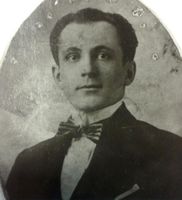
Fortunato Picchi was born in Carmignano, near Florence, Italy, on the 28th August 1896. He joined the Italian Army during the First World War and served in Macedonia with the 64th Infantry Regiment. Following the Armistice, he worked in the hotel trade before emigrating to Britain in November 1921, where he spent 14 years working at the Savoy Hotel, eventually becoming head waiter before moving to the Flemings Hotel. Picchi came to regard Britain as his home, and although he did not claim to have any particular political leanings, he was certainly an anti-Fascist, and so when war was declared he was extremely eager to help his adopted nation in any way that he could.
During World War Two a significant number of soldiers of Italian descent fought within the armies of Allied nations such as Britain. Many belonged to families of immigrants who left Italy in the late 19th and early twentieth centuries. Others were born in Italy and emigrated during the inter-war years in search of better opportunities or to avoid Fascist persecution.
This thesis proposes a new perspective on Italian partisans & British forces' relations during the Italian campaign of 1943-194. It challenges many assumptions that are still present in Italian and Anglophone historiography on the subject and creates a final interpretation that enriches current historiography.
Dennis Donnini was born to Italian-born Alfred Donnini and his English wife Catherine (née Brown), on 17th November 1925 in Easington Colliery. He had two brothers, both of whom entered the military -- Alfred was captured at Dunkirk and spent the rest of the war in a POW camp, while Lewis died of wounds on 1st May 1944. Dennis was 19 years old, and a fusilier in the 4th/5th Battalion, Royal Scots Fusiliers when the following deed took place for which he was awarded a posthumous VC. The citation reads: “War Office 20th March 1945 The KING has been graciously pleased to approve the posthumous award of the VICTORIA CROSS to: No. 14768011 Fusilier Dennis Donnini, The Royal Scots Fusiliers (Easington Colliery, Co. Durham).
During the second world war, millions of people arrived in Britain from all over the world, including occupied Europe. They kept essential industries going as war workers, served in the armed forces, worked at the BBC and nursed the sick. Britain’s war effort was multinational and multiracial – just like the effort to save people’s lives and keep essential work going during the coronavirus pandemic.
Around 7,000 men of Italian origin served in the British Army during the Second World War, including 331 who died. Following Italy’s declaration of war on Britain in June 1940, second-generation male Italians were torn between their military obligations as British citizens and their familial identities as sons of the ‘enemy’. The fact that many British Italians were of dual nationality, deriving Italian citizenship from their father and British citizenship from their place of birth, made the fact of serving in the British Army a complex and symbolic act. A major stumbling block for many British Italian soldiers was that they had to succumb to the manpower demands of the very state that had interned their fathers or relocated their mothers from their homes.
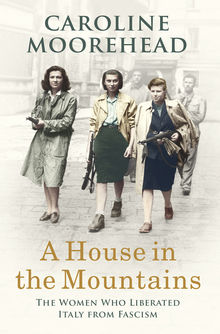
Most people are acquainted with at least the basic facts about the French Resistance. There are copious popular books, plays and films, and of course, the much-loved BBC comedy ‘Allo 'Allo. But few are quite so well versed on another resistance movement that played out in Europe towards the end of World War II. Just across the Alps, Italians were protesting German occupation and hiding out in the homes of willing locals. Despite the fact that many British and Commonwealth nationals lived and fought alongside the Italian partisans, this entry in Italy’s history has largely been ignored.
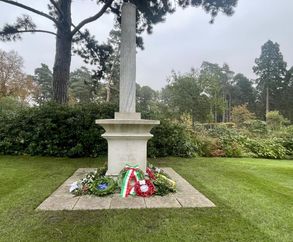
Brookwood Military Ceremony.
Italian Area, commemorative pillar, broken
Cared for by the Commonwealth War Graves Commission, the cemetery contains Italian, French, Polish, Czechoslovakian, American, Canadian and Belgian military sections.
The Italian section has the graves of Prisoners of War who died whilst in Britain. Those internees who died in the sinking of the Arandora Star are also commemorated at Brookwood.
The Second World War Network (Scotland) formally launched in April 2021. Dr Wendy Ugolini, School of History, Classics and Archaeology and Professor Tobias Kelly, School of Social & Political Science, were awarded a Royal Society of Edinburgh (RSE) Arts & Humanities Research Network Award to run a Second World War Network in Scotland. Previously, in 2019 they hosted the ‘New Directions in Second World War Studies’ interdisciplinary workshop which brought together researchers in the field to discuss their work and to flag up themes which would be of importance during the 80th anniversary commemorations of the conflict (2019-2025).
At the end of April 1945, victorious Allied troops finally forced their way into the north of Italy after months of stalemate in the Apennine mountains of central Italy. To their surprise, they found not German troops in command of the major towns and cities of northern Italy, but Italian partisans. The forces of the Italian Resistance were in a seemingly impregnable position of power: they had emerged victoriously from an eighteen-month-long armed struggle against the German occupying army and Fascist Republic of Salò. They had liberated the towns and cities of the north; they had successfully protected the northern industrial infrastructure from destruction at the hands of the Germans; and they had installed Committees of National Liberation (CLN) throughout the north. These committees controlled local government, industrial production, and public utilities, instigating the purging of Fascists from government bureaucracy and private industry. Within a month of the Allied breakthrough their leaders would be installed in power heading a government of national unity under the leadership of the Action Party’s (PdA) Ferruccio Parri.
In September 1944, a heavily pregnant Resistance activist in the north of German-occupied Italy was arrested on a visit to Milan. Lisetta Giua, a law student and fiancée of the Jewish anti-Fascist chief Vittorio Foa, worked as one of hundreds of women staffette: vital underground operatives whose roles might stretch from courier and spy to liaison officer and saboteur.
*Alien: in an era of science fiction movies such as ET (Extra Terrestrial) this term can sound out of place, even offensive. It was first used in the 14th century to describe something that felt strange or was of foreign origin. The UK government and institutions now prefer more neutral and respectful language when discussing immigration and foreign nationals. Instead of “alien” terms like “foreign national” or “non-citizen” are used in legal and government contexts. In 2021 US government agencies dealing with immigration were instructed to change their official language practices. Terms like “alien”, “illegal alien” and “assimilation” are no longer used. Instead, new vocabularies apply, including the words “noncitizen” for “alien” and “integration” for “assimilation”.
* Shoah: the Hebrew word for “catastrophe,” referring to the killing of nearly six million Jews in Europe by Nazi Germany and its collaborators during the Second World War. English-speaking countries more commonly use the word Holocaust, which is Greek for “sacrifice by fire”.
* Partisans: this can refer to a strong supporter of a party, cause, or person or describe a member of an armed group formed to fight - sometimes secretly - against an occupying force, for example the one that was operating in Fascist or German occupied Italy during the Second World War.
Click on the links below and in the side panel to the left to discover more information to guide your research:
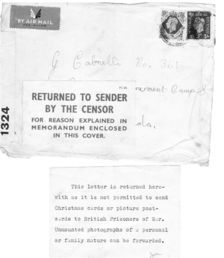
'In recent decades there has been a marked growth in scholarship on the internment of continentals in Great Britain during the Second World War ... information is still coming to light to build an even more nuanced and full picture of what happened to ‘enemy aliens’* during this period. From fragmented records, detective work has been required to fully reconstruct exactly what happened during this time period and how it has been remembered and commemorated. This volume has been created to fill a gap in internment scholarship and to offer a comparative approach that considers the internment of continentals in Britain alongside the internment of Britons on the continent.'
A talk given by Dr Rachel Pistol talks on Internment, the Arandora Star tragedy and internees taken to Australia on the HMT (Hired Military Transport) Dunera.
The Arolsen Archives have the largest collection of information on Nazi victims, including documents on concentration camps, forced labour and displaced persons.
The Tatura group of 7 internment camps held between 4 and 8,000 people at any one time; these camps were located at Tatura (camps 1 and 2), Rushworth (camps 3 and 4), Dhurringile Mansion, Murchison (camp 13) and Graytown.
A podcast of a BBC programme about the internment of Italian nationals on the Isle of Man, including the experience of Scots Italian actor Tom Conti's family.
*Alien: in an era of science fiction movies such as ET (Extra Terrestrial) this term can sound out of place, even offensive. It was first used in the 14th century to describe something that felt strange or was of foreign origin. The UK government and institutions now prefer more neutral and respectful language when discussing immigration and foreign nationals. Instead of “alien” terms like “foreign national” or “non-citizen” are used in legal and government contexts. In 2021 US government agencies dealing with immigration were instructed to change their official language practices. Terms like “alien”, “illegal alien” and “assimilation” are no longer used. Instead, new vocabularies apply, including the words “noncitizen” for “alien” and “integration” for “assimilation”.
The Tatura group of 7 internment camps were established in this area because of the distance from a sea port and availability of adequate food and water. Holding between 4 and 8,000 people at any one time, these camps were located at Tatura (camps 1 and 2), Rushworth (camps 3 and 4), Dhurringile Mansion, Murchison (camp 13) and Graytown. Camps 1 and 2 were for single males, mostly German and Italian. Camp 3 was for mostly German family groups. Camp 4 was for Japanese family groups. Dhurringile Mansion was for POW officers and their batmen. Camp 13 was for Italian and German prisoners of war, and some Japanese were transferred there after the Cowra Breakout. This camp is the site of the HSK Kormoran Memorial. Graytown Camp was used for Italian, German and Finnish POW’s who were occupied with woodcutting to supply the camps and hospitals. A garrison of guards and other support staff, including nurses were stationed outside the compounds. Field Hospital 28 was constructed at Camp 1 where over 100 Japanese babies were born. None of the camps are accessible as they are on private property and Dhurringile Mansion is now a part of HM Prison Dhurringile.
 an campaign of 1943-194. It challenges many assumptions that are still present in Italian and Anglophone historiography on the subject and creates a final interpretation that enriches current historiography.
 en more nuanced and full picture of what happened to ‘enemy aliens’* during this period. From fragmented records, detective work has been required to fully reconstruct exactly what happened during this time period and how it has been remembered and commemorated. This volume has been created to fill a gap in internment scholarship and to offer a comparative approach that considers the internment of continentals in Britain alongside the internment of Britons on the continent.'