

© 2025 - Anglo Italian Family History Society
Website by Beachshore
Click on the links below or on the side panel to the left and discover more information to guide your research:
The study of two Italian organisations in London and their role in constructing an Italian 'community', at a time when the Italian population is fragmented and dispersed. Fortier discusses new forms of identity forged within these settings and developments which defy simple notions of 'community' and continuity based on a primary ethnicity. Languages of solidarity, in the two organisations, are generated by a group of claims about the historical, political and cultural presence of Italians in Britain. She argues that the relationship between family and cultural continuity is mediated through generations, while authenticity is configured around gender. Definitions of local particularity are drawn from deeply held ideas about gender differences and sexual behaviours, which provide some form of ontological security that fixes the relationship between family, ethnicity and community.
Owing to its geographical location and the collapse of its fishing and shipping industries, the UK city of Kingston upon Hull post-WWII rapidly acquired a reputation as a declining outpost of the British nation with no real links to the rest of the world. Yet, historically, Hull has always been a multicultural city that welcomed different migrant communities. Links with Italy, for instance, date back to the 1500s, as the recent ‘Italian Connections’ exhibition, held in one of the local museums, has shown. This exhibition was then also the opportunity to rediscover and reaffirm the existence of an Italian community in the city. This article presents a selection of stories from members of this community, which emerged during and immediately after the exhibition, as a means of exploring the nature of Hull’s historic Italian community and to analyse the extent to which an ‘Anglo-Italian’ identity emerges in this case. It focuses in particular on two case studies: the Coletta and Bottery families. Hirsh’s notion of post-memory and Bedingfield’s idea of trans-memory are used to investigate how members of these families view their Italian background and construct their identities, how memories are transmitted and “translated” across generations, which external factors impacted on their identity construction, and which image of Italy emerges from their recollections. Being able to discuss their family history matters to this group of people: they see this opportunity both as a mechanism by which to reaffirm their personal histories and heritage and as a way to uncover a hidden aspect of Hull’s past which can impact positively on the city’s future.
Short documentary capturing the last traces of London’s very own Little Italy. Officially selected for the London Short Film Festival 2016.
Italians in Clerkenwell, London: Lusardi
An archived copy of a story from the UK National Archives.
During the 19th century immigrants from diverse origins began to settle in Liverpool, the main motivation for their arrival was work. Liverpool had become a principal port with substantial dockland that was receiving products from all over the world such as tobacco, cotton and sugar.
Creating a Community: Godparents and Organ Grinders in Victorian London: (podcast) Members Only.
A Contact Variety of English: the Case of the Bedford Italian Community. Siria Guzzo
The town of Bedford in the British East Midlands has a large Italian diaspora community that began to arrive in the early 1950s to seek employment in the local brick works. Ethnically Bedford is one of the most highly mixed communities in Britain and is home to over a hundred immigrant languages, including Italian together with Punjabi, Turkish, Polish, Portuguese, Cantonese and Mandarin Chinese... According to the 2001 census, 2 in 7 of Bedford’s population are of Italian origin, which means that the 28% of today’s Bedfordians belong to the Bedford Italian Community ... overall numbering 42.261 Italians. Significantly, Bedford is the only non-capital city in the world to have had its own Italian vice consulate which was opened in town in 1954 to look after the needs of the Italian settlers, and closed in 2008.
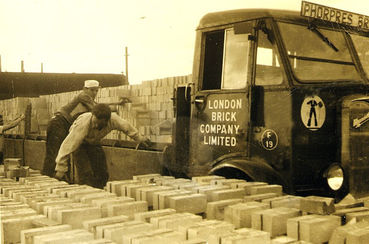
Italians in Bedford: British identity and society
Article on Italians in Bedford: Bedford is the town that is home to the largest concentration of Italian families in the UK - 14,000 people from a total population of around 100,000.
Italian immigration to Bedford
Bedford’s Italian community from the post-war reconstruction period when economic necessities in Italy and Britain triggered migration from impoverished villages in Southern Italy to work in the brickworks industry in Bedford
The Di Felices of Manchester, Birmingham and Picinisco
See newspaper item on the right of this page.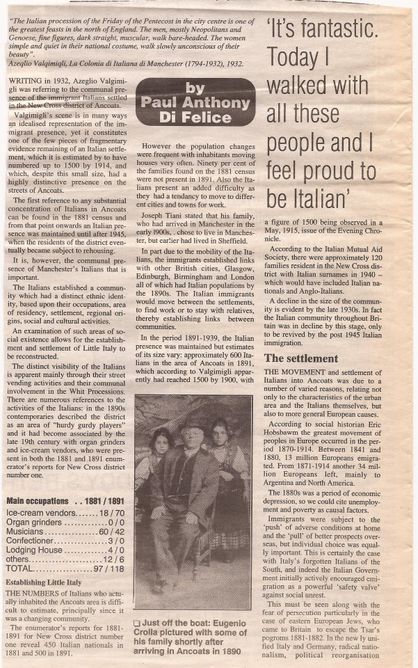
Italian migrants to Manchester, England: Anthony Rea
In the 19th century there was an exodus of Italian immigrants, due to the country's political and economic situation. They travelled from every region of Italy to the United Kingdom, particularly from Lazio and Campagna. Some settled in the Ancoats area of the city of Manchester, in north west England, creating what became known as "Ancoats Little Italy". They enhanced the existing Catholic Whit Walk, pioneered the British ice cream industry, and survived the turmoil of the second world war.
In the decade following the end of the Second World War, a mass migration of Italian workers came to the United Kingdom to be employed in Britain’s factories and mines. Amongst these, many were women. Thanks to official recruitment schemes drafted by the British and Italian governments of the time, young women left Italy in their thousands, to be employed as domestic workers or in factories, especially in the textile districts of Lancashire and Yorkshire. Here, they joined other migrants recruited through the European Volunteer Workers scheme, a government-led operation aimed at sourcing manpower from mainland Europe. The Official Italian Scheme was one of such recruitments, but one of the least investigated. Gasperetti begins by studying the process of recruitment of young Italian women, within the wider context of Italy’s post-war emigration policies and its diplomatic relations with Great Britain ... the research focusses on the entry of Italian women in the textile districts of Greater Manchester, Lancashire and Yorkshire and the process of their integration within British society ... the thesis examines the attitudes of Catholic missionaries in Britain, the Italian expatriate community, the implications arising from mixed marriages and the formation of new multicultural families.
THEY LIVED IN LEEDS Vincenzo Luigi Tomasso (1862-1944): Musician and barrel-organ maker
For forty years Luigi Tomasso ran a unique business in Hunslet making barrel-organs, mostly for hire by street performers. When his workshop closed in 1942 it was one of only four left in the country and its long decline marked the end of an era – the disappearance of the ‘tingalary man’ from the streets of Leeds, churning out his popular tunes, sometimes accompanied by a monkey or a small appealing child to win people’s hearts and pennies.
Reading's Little Italy: Italian migration to Britain
Museum exhibition in Reading, Berkshire, England
Many of us know of Clerkenwell's 'Little Italy', or the famous coffee bars in Soho, but how much do you know about Italian's impact on Southwark? From skilled craftsmen in the early 19th century to ice-cream vendors, no stone is left unturned as a light is shone on the visible identity Italians have had for centuries.
Gatti's Ice House, Kings Cross, London
Before the early years of the 19th century ice was gathered from ponds, rivers, and canals and was stored in underground ice stores. Ice began to be imported from Norway in the 1820's and it was necessary to dig large ice wells in London in order to store it to meet the growing demand. Luxury items like ice cream had to be made fresh and eaten straight away, there was no mechanical refrigeration until around the turn of the century. Carlo Gatti (1817-78) was a Swiss Italian who came to England in the 1840s and started a cafe at Charing Cross which - an innovation. It was a great success and he soon expanded his business to include cafes and restaurants.
With increasing numbers of older migrants adopting a transnational lifestyle or returning to their country of origin following retirement, the sense of attachment to and identification with the places they inhabit remains an under explored field of enquiry ... By highlighting the perspective of older Italian migrants living in Newcastle upon Tyne, UK, this paper illustrates the role of a sense of identification with the context of migration in later life.
Place attachment and place identity amongst older Italians in Newcastle upon Tyne Simona Palladino
In the social gerontology literature, there is a wide agreement on the importance of affective bonds with places for a positive experience of ‘ageing-in-place’. This includes a sense of attachment to and identification with places, also defined as a ‘sense of home’. However, the ways in which these affective bonds with places are negotiated by ageing migrants is yet a fairly neglected area of research. Nevertheless, with increasing numbers of older migrants adopting a transnational lifestyle or returning to the country of origin after retirement, there is a pertinent need to explore ageing migrants’ meanings of the affective bonds with places.
AIM25: archives in London and the M25 area. Collection level descriptions of the archives of over one hundred higher education institutions, learned societies, cultural organisations, livery companies within the greater London area.
Friends of Ravenna, Chichester
The twinning of Chichester, West Sussex, England and Ravenna, Emilia-Romagna, Italy focusses on links between the two, but expands to an interest in Italy, land and culture.
From Bedford to London: new patterns of Italian immigration to the united kingdom
Website by Beachshore